We use AI naturally in our daily lives—at work, in our studies, and for everyday tasks. It’s becoming almost invisible in how seamlessly it supports us.
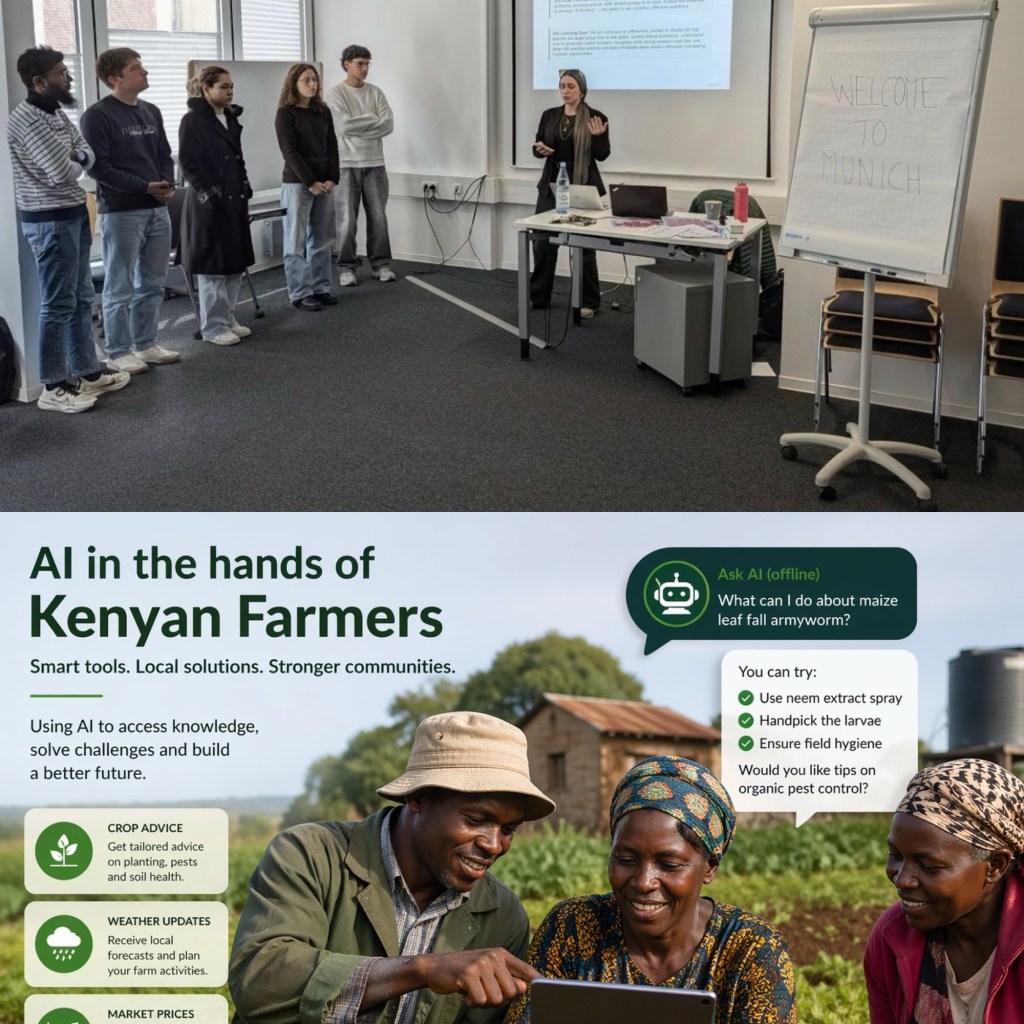
But this raises a more important question:
How can people in different contexts—such as communities in Kenya—learn to apply AI effectively in ways that truly matter to them?
Especially when access to technology is limited, and learning environments are often low-tech?
Turning AI Into a Practical Skill
This question was at the heart of a recent workshop:
“AI for Community Empowerment – Building Offline AI Starter Kits for Kenya”,
as part of the Erasmus Sustainability Week.
Together with SCN Kenya we focused on a very concrete challenge:
How can AI skills—especially prompting and practical application—be taught in a way that is simple, accessible, and context-relevant?
Learning by Doing Across Borders
International student teams from:
- Iscte – Instituto Universitário de Lisboa
- Vilnius Business College
- Macromedia University of Applied Sciences
worked collaboratively to design offline-ready AI Starter Kits tailored to real community needs.
These kits were developed for:
- teachers and students
- farmer communities
- youth groups
- NGO staff
What made this work particularly powerful was its practical orientation.
Instead of focusing on theory or complex tools, the teams emphasized:
- simple, actionable prompts
- relatable, real-life use cases
- low-tech formats that work without constant internet access
The result: solutions that are not only understandable—but immediately usable.
And importantly, these outputs are not just prototypes. They can be directly applied by SCN Kenya in their ongoing work with communities.
A Shift in Perspective on AI
One key insight stood out throughout the workshop:
AI is not just about access to tools.
It’s about building the capability to use them meaningfully.
This distinction is critical.
Because without the skills to apply AI in context, access alone does not lead to impact. But when people understand how to use AI to solve real problems in their daily lives, it becomes a powerful enabler.
AI Education as a Driver for Equality
This is where AI education connects directly to broader sustainability goals.
By making AI skills accessible, practical, and inclusive, initiatives like this contribute to greater equality of opportunity. They empower individuals not just to consume technology—but to actively shape how it is used in their communities.
Collaboration That Makes a Difference
What made this workshop truly inspiring was the collaboration:
Different countries, different perspectives, one shared goal—making AI usable where it matters most.
A big thank you to all students, partners, and contributors who brought this to life. This kind of cross-border, purpose-driven collaboration shows what is possible when innovation meets real-world needs.

