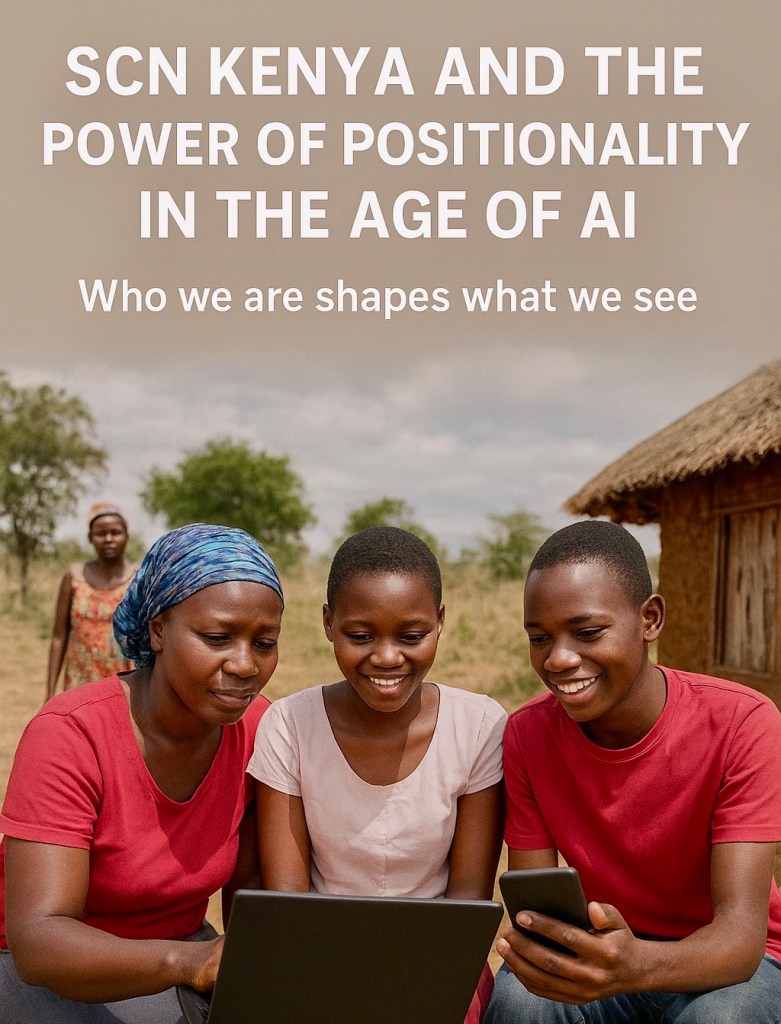
What does access to ChatGTP & co mean for farmers, fisher communities and communities living in disadvantaged environments?
Artificial Intelligence is transforming how people access knowledge — but not everyone starts from the same place.
Our positionality — where we live, what we’ve experienced, and the opportunities we’ve had — still shapes how we can use technology.
At System Changer Network (SCN) Kenya, we recently spoke with families in slum areas, and with fisher and farmer communities.
Their voices highlight both the challenges and the opportunities ahead:
1️⃣ Digital literacy, internet, and device access remain the foundation. Without them, AI inclusion is impossible.
2️⃣ Once people gain access, language-based AI tools spark genuine excitement — especially when they connect to everyday needs like farming, health, or small business ideas.
3️⃣ The real breakthrough comes with learning to formulate strong prompts — asking questions that lead to practical, empowering, and innovative answers.
4️⃣ Many still face limited exposure to other regions, examples, and possibilities — a quiet barrier that holds back curiosity and innovation.
That’s why our trainings combine virtual exploration with real-world examples, encouraging people to discover, imagine, and apply what they learn.
When local changemakers begin to use AI consciously, they move from being subjects of data to authors of transformation.
Each prompt becomes a bridge — between local knowledge and global opportunity, between poverty and potential, between today’s reality and tomorrow’s possibility.
💬 We’d love to hear from you:
How can AI truly become inclusive — not just accessible?
 Go Kenya, go future!