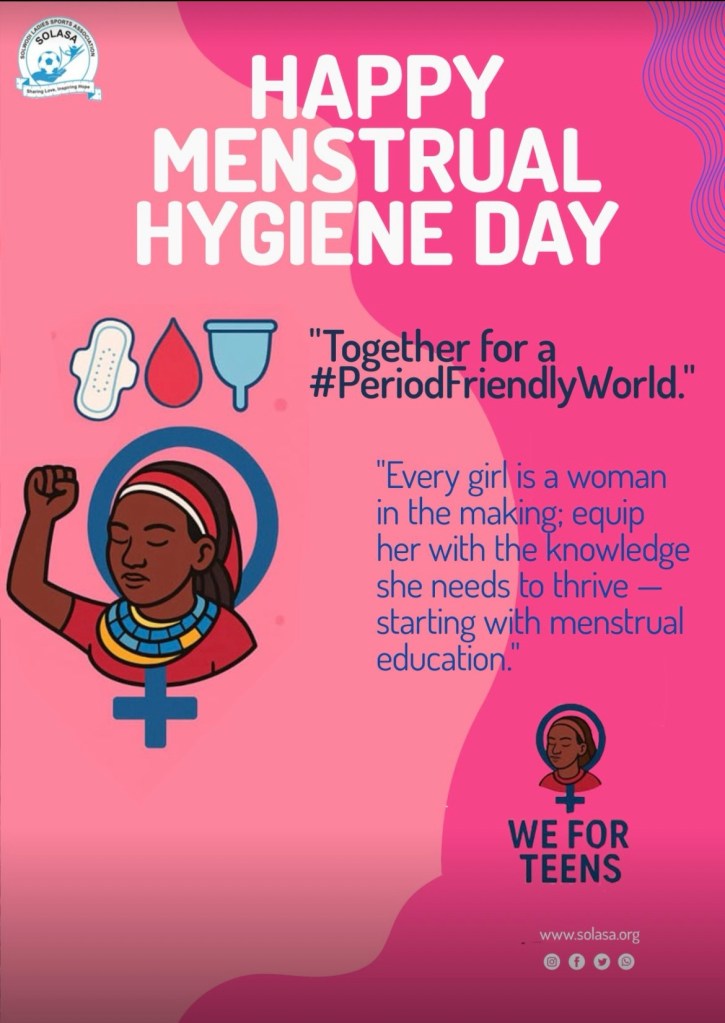
No girl should ever miss school, feel ashamed, or suffer in silence because of her period. Yet for millions of girls and women across Kenya and beyond, menstruation remains a barrier—one that affects education, confidence, participation in daily life, and access to opportunity. Today, on Menstrual Hygiene Day, we reaffirm our commitment not only to breaking the silence and ending the stigma, but to embedding menstrual health in the broader work of systemic change.
Through our network of NGOs, community leaders, and grassroots changemakers, we are scaling local solutions that work, sharing tools, and strengthening frameworks that tackle these complex, interconnected challenges.
We have seen firsthand how lack of access to menstrual products and education disproportionately affects vulnerable girls, especially those in low-income or rural areas. When girls stay home during their periods or are too embarrassed to ask for help, they fall behind in school, risk dropping out, and often suffer in silence. The ripple effects impact not only their futures, but the well-being of their families and communities.
That’s why our local empowerment programs are built around systemic thinking and active collaboration. Together, we:
✅ Provide menstrual hygiene education in schools and community centers
✅ Distribute pads to girls and teen mothers, with a focus on dignity and sustainability
✅ Create safe spaces for open conversations, led by trusted local mentors
✅ Equip girls with knowledge, confidence, and a sense of agency
But we don’t stop there. By embedding these initiatives within a networked framework, we foster learning between partners, measure collective impact, and advocate for policies that prioritize menstrual equity as part of health, education, and gender strategies. When communities, NGOs, and stakeholders align under a shared vision, we see real change—change that can scale, endure, and shift systems from the inside out.
Solasa is an active member, we see menstrual health as more than a hygiene issue—it’s a window into structural inequalities that require collaborative, cross-sector solutions. We care not just about menstruation, but about the many interconnected challenges that shape daily life for vulnerable communities. From access to clean water and reliable energy, to preventive healthcare, healthy farming practices, mobility, kitchen gardening, and local income generation—our work embraces the full spectrum of needs that must be addressed to create lasting, systemic change. Each issue is part of a larger puzzle, and only by working holistically and through strong local networks can we co-create solutions that are truly transformative.
On this Menstrual Hygiene Day, we’re not just talking about periods. We’re talking about equity, access, and power. We’re building systems where no girl has to choose between dignity and education, and where local innovation is supported to grow across regions.
 Go Kenya, go future!